
Personalized Alignment Knee Replacement
Personalized Alignment: A Knee Replacement Designed for You
For decades, traditional knee replacement has relied on mechanical alignment: positioning the components according to standardized measurements and attempting to make nearly every knee “straight.” In simple terms, mechanical alignment tries to put every knee replacement into a standardized position, a one-size-fits-all approach, while personalized alignment tries to determine the ideal position for your knee to restore your natural knee mechanics.
The principles of mechanical alignment were developed largely around the technology and implant designs available in the 1980s. At that time, surgeons were appropriately concerned that placing components outside a narrow range of alignment could lead to uneven loading, premature wear, loosening, and earlier failure. Creating a neutral mechanical axis became an important strategy for maximizing implant durability.
Knee replacement technology has changed dramatically since then. Modern implant materials, fixation, surgical instrumentation, computer navigation, and robotic technology allow us to measure and reproduce knee anatomy with much greater precision. Importantly, long-term studies, including follow-up extending beyond 15 years for some personalized and kinematically aligned knee replacements, have demonstrated that modern knee replacements can tolerate greater variation in alignment without necessarily compromising implant durability.
Restoring Your Individual Knee Mechanics
Every patient’s knee is different. There are nine different ways that the femur and tibia are aligned and articulate at the knee joint. We can classify your knee as one of nine types using the CPAK (Coronal Plane Alignment of the Knee) classification, which is pictured on the Patient Care Philosophy page.
Some people naturally have a small amount of bow-legged or knock-kneed alignment. The angles of the thighbone and shinbone, the orientation of the joint surfaces, and the tension of the ligaments also vary from person to person. Personalized alignment recognizes these differences.
Rather than using a “one-size-fits-all” strategy, personalized alignment attempts to restore the patient’s individual knee anatomy, ligament balance, and natural knee mechanics. The goal isn’t simply to recreate bow-legged or knock-kneed alignment. Instead, it is to determine a safe position for the implants that respects how that patient’s knee was naturally built and how it was designed to move.
By more closely restoring an individual’s knee mechanics, personalized alignment may allow the knee replacement to feel more natural, reduce the need for ligament releases, improve knee balance, and potentially improve function and patient satisfaction.
Modern personalized alignment is also not an “anything goes” approach. Surgeons can use defined guardrails to prevent implant positioning from moving beyond ranges considered safe for the implant and the patient.
The concept is simple: we aren’t trying to make your knee look like everyone else’s knee. We are trying to restore the mechanics that are right for your knee, while staying within safe boundaries designed for long-term durability.
Computer-Assisted Surgery and Smart Implants
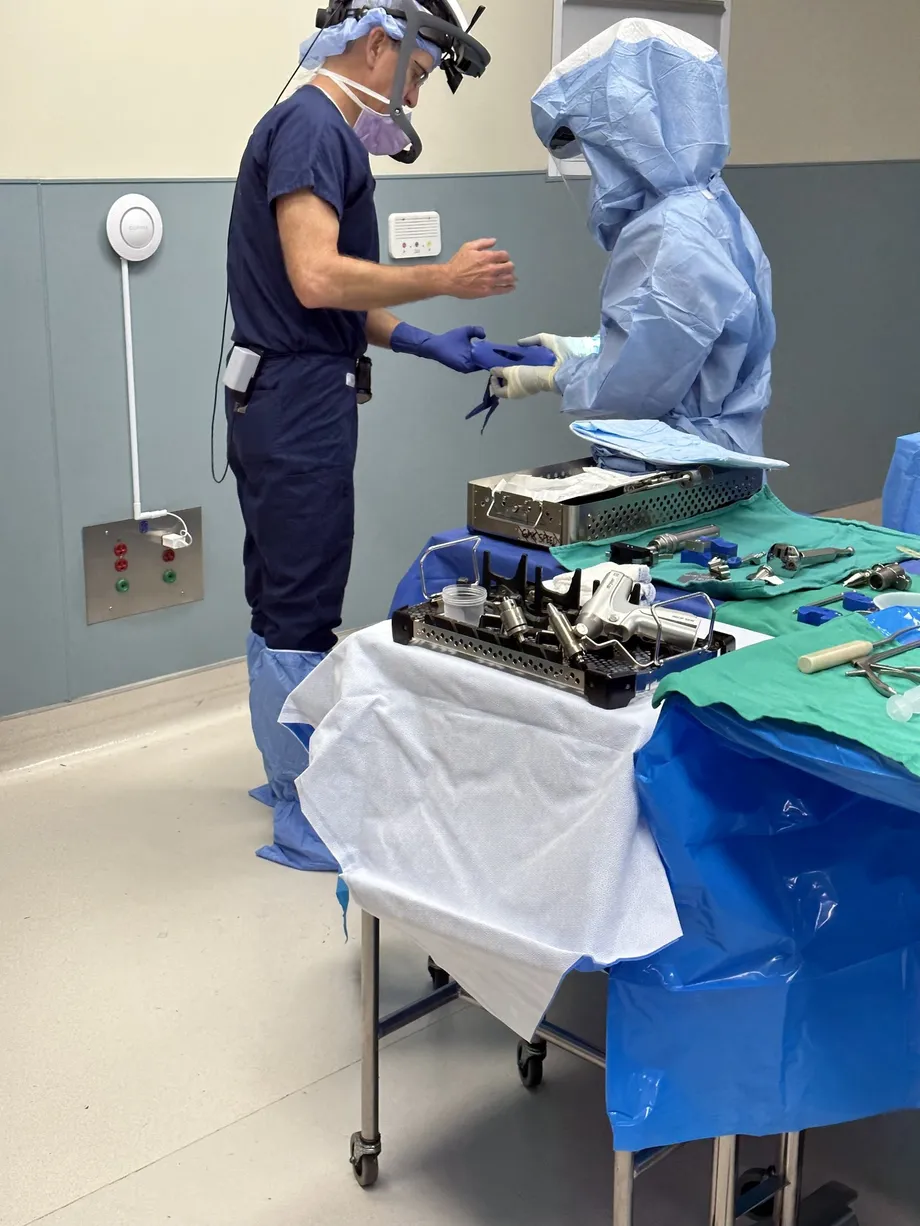
For knee replacement, Dr. Maish combines computer-assisted surgery in the ROSA® robotic system with this highly personalized approach to reconstruction. The technology helps execute the surgical plan with precision while allowing the surgeon to make decisions based on the individual patient’s anatomy and natural mechanics.
Dr. Maish has also embraced smart implants (Persona IQ®) and emerging digital technologies that can provide objective information about patient function and recovery following joint replacement. Recording outcomes is critical, and these technologies paired with the American Joint Replacement Registry allow the success of his procedures to be measured for years to come.
Persona® Knee: Components Designed to Fit Your Individual Anatomy
Just as every person’s face is different, every person’s knee has a different size and shape. The width and contour of the femur (thighbone), the shape of the tibia (shinbone), and the relationship between these bones can vary considerably from one patient to another.
The Zimmer Biomet Persona® Personalized Knee® was developed after extensive research into human knee anatomy. During its development, researchers used advanced analysis techniques to study hundreds of knees, examining differences in the size and shape of the femur and tibia. The goal was to create knee replacement components that more closely reproduce the wide range of anatomy found in actual patients.
More Sizes, With Smaller Differences Between Sizes
Traditional knee replacement systems offer a limited number of implant sizes. Sometimes this can leave the surgeon choosing between a component that is slightly too small and one that is slightly too large.
The Persona system provides 12 femoral sizes and 21 distinct femoral profiles, including both standard and narrow options. Most femoral sizes increase in very small 2-millimeter increments. This allows the surgeon to make much finer adjustments when matching the implant to the patient’s bone.
The tibial component is also anatomically shaped and is available in nine sizes with separate right- and left-knee designs. Rather than simply making the same basic shape larger or smaller, the design accounts for the way the shape and proportions of the tibia change as the bone becomes larger.
Why Does a Better Fit Matter?
An implant that is too large can extend beyond the edges of the patient’s bone and potentially irritate the surrounding soft tissues. An implant that is too small may not adequately cover the bone or reproduce the patient’s natural knee dimensions.
Having more shapes and smaller differences between sizes gives the surgeon more choices to match the implant to the individual patient rather than making the patient fit the implant.
This complements the philosophy of personalized alignment. Personalized alignment focuses on restoring how your individual knee is positioned and moves, while the Persona implant provides a wide range of sizes and shapes to more closely match your individual anatomy.
Together, the goal is to move away from a “one-size-fits-all” knee replacement and toward a knee replacement designed around your anatomy, your ligament balance, and your natural knee mechanics.
ROSA®, Persona®, Personalized Knee® and Persona IQ® are trademarks of Zimmer Biomet.
Ready to talk about your hip or knee?
Dr. Maish spends an hour with you and your family so that you understand your options.
Or call 301-663-9573 and ask for Michele.