
Subvastus Approach Knee Replacement
What is the subvastus approach?
Every knee replacement starts the same way: the surgeon has to get into the knee joint. Most surgeons do this through a medial parapatellar approach, which cuts through the quadriceps tendon just above the kneecap. The subvastus approach gets to the same joint a different way. Dr. Maish goes underneath the lowest part of the quadriceps muscle, the vastus medialis, and lifts it aside. The quadriceps tendon is never cut.
I usually describe the concept to patients this way: “Instead of cutting through the quadriceps mechanism to get into the knee, we go underneath the muscle and move it aside. At the end of the operation, the quadriceps mechanism is still intact.”
The approach does not change the knee replacement itself. The damaged joint surfaces are still replaced in the same way. What changes is how the surgeon gets in and out of the knee, with the goal of leaving the muscles and tendons that straighten your leg undisturbed.
The anatomy: why the quadriceps matters
The quadriceps is the group of four muscles on the front of your thigh. They join into one tendon that attaches to the top of the kneecap, and from the bottom of the kneecap the patellar tendon continues to the shinbone. Together this is the extensor mechanism: it is what straightens your knee, lets you stand from a chair, climb stairs and hold your leg out straight.
The vastus medialis is the innermost of the four muscles, the teardrop-shaped muscle just above and inside the kneecap. It is the first muscle to weaken after any knee injury or operation and the hardest to get back. The subvastus approach passes beneath it rather than through the tendon it feeds, which is why the early recovery can look different.
Who is a candidate
Dr. Maish’s mastery of this approach allows him to offer it to all patients, with extremely rare exceptions. It is used for primary total knee replacement whether the knee is bow-legged or knock-kneed, and it is combined with the rest of his approach: personalized alignment, Persona® implants matched to your anatomy, and computer-assisted surgery with the ROSA® robotic system.
When it may not be used
- Some revision operations, where the knee has been replaced before and the old incision and scar tissue dictate the approach.
- Certain severe deformities or a very stiff knee, where the joint cannot be exposed safely underneath the muscle.
- Rare cases decided during surgery. Dr. Maish will always choose the approach that lets him do your operation safely.
The procedure, step by step
- Incision. A single incision on the front of the knee, the same as for a standard knee replacement.
- Going under the muscle. Instead of cutting the quadriceps tendon, Dr. Maish frees the lower edge of the vastus medialis and lifts the muscle up and to the side, then opens the joint capsule beneath it.
- Exposing the joint. The kneecap is moved aside without cutting the tendon above it, giving a full view of the ends of the thighbone and shinbone.
- Planning and bone preparation. Using the ROSA robotic system, the bone cuts follow the plan made for your knee, positioned according to personalized alignment rather than a one-size-fits-all target.
- Implant placement. The Persona components are sized to your bone and cemented in place, and the ligaments are balanced so that the knee is stable through its whole range of motion.
- Closing. The muscle is laid back into place. Because no tendon was cut, there is no tendon repair to protect while you recover.
Advantages of the subvastus approach
- The quadriceps mechanism stays intact. The tendon that straightens your leg is never cut.
- Less early pain. In randomized trials, patients report less pain in the first days after surgery compared with the standard approach.
- Earlier control of your leg. Straight-leg raise returns about 1.7 days earlier on average.
- Better early motion. Knee bend is about 7 degrees greater at one week.
- Earlier milestones. Independent walking and stair climbing tend to come sooner, and in one randomized comparison patients gave up the cane around 14 days instead of 20.
- A recovery plan built around it. A muscle-sparing approach fits with opioid-sparing pain control and the Less Swelling, Less Pain plan, so the early advantage is not lost to swelling.
What the research shows
Across multiple randomized controlled trials and subsequent systematic reviews, the subvastus approach to total knee arthroplasty has demonstrated advantages in early postoperative recovery compared with the traditional medial parapatellar approach. By preserving the quadriceps tendon and minimizing disruption of the extensor mechanism, subvastus knee replacement has been associated with earlier return of straight-leg raise and quadriceps strength, less early postoperative pain, improved early range of motion, and earlier achievement of functional milestones such as independent walking and stair climbing.
Meta-analysis of randomized trials suggests that straight-leg raise returns approximately 1.7 days earlier and early knee motion is approximately 7° greater at one week. More recent 2024 to 2026 studies generally reinforce this pattern of improved early quadriceps function and functional recovery, while showing that longer-term outcomes tend to become similar between the two approaches.
The evidence regarding discontinuation of walking aids is less extensive but is consistent with the possibility of faster early functional independence. In one randomized comparison, average cane discontinuation occurred around 14 days with a mini-subvastus approach versus around 20 days with a medial parapatellar approach. That is a difference of roughly five and a half days, although it was not statistically significant.
Taken together, the evidence supports describing the principal advantage of the subvastus approach as a faster early recovery rather than a superior long-term knee replacement. Patients may regain quadriceps control, motion, and functional independence sooner, while by several months the outcomes of the two surgical approaches generally converge.
Teaching the approach
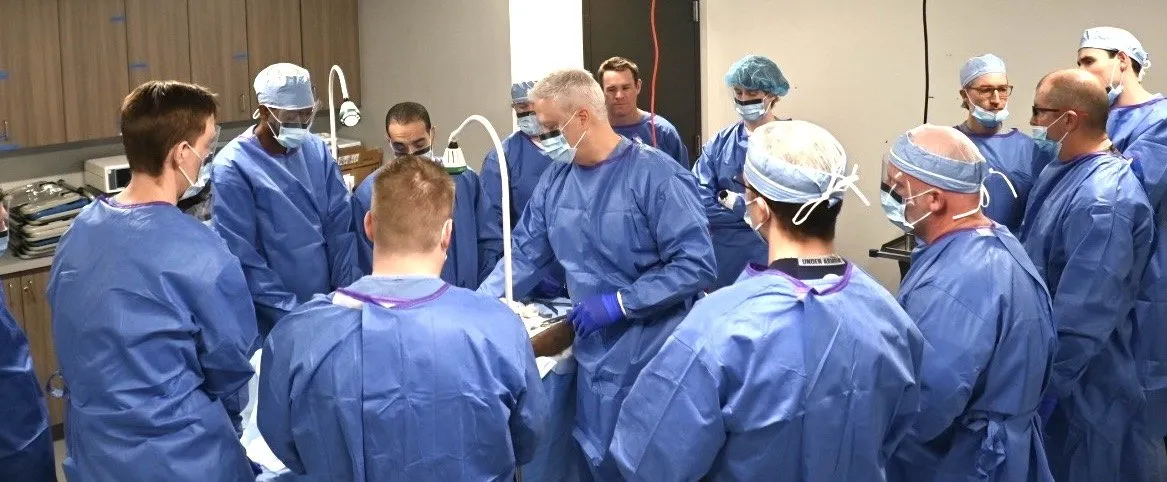
In January 2026 Dr. Maish led a cadaver training lab in the subvastus approach for local surgeons and residents from Johns Hopkins.
Related: total knee replacement, personalized alignment and implants, ROSA robotic surgery.
This page is general education, not medical advice. Only an examination and a conversation with your surgeon can tell you what is right for you.
A muscle-sparing way into the knee
Most knee replacements are performed through a medial parapatellar approach, which cuts through the quadriceps tendon to reach the joint. With the subvastus approach, Dr. Maish goes underneath the quadriceps muscle and moves it aside instead of cutting through it.
I usually describe the concept to patients this way: “Instead of cutting through the quadriceps mechanism to get into the knee, we go underneath the muscle and move it aside. At the end of the operation, the quadriceps mechanism is still intact.”
The potential advantage is that the quadriceps mechanism remains intact. In some patients, this can mean less early postoperative pain, better early quadriceps function, and an easier time performing activities such as straight-leg raises and walking during the first few days after surgery.
The important caveat is that the approach doesn’t change the fundamental knee replacement operation. The damaged joint surfaces are still replaced in the same way. The primary difference is how the surgeon gets into and out of the knee, with the goal of minimizing disruption of the muscles and tendons that help patients regain strength and mobility.
Dr. Maish’s mastery of this approach allows him to offer it to all patients, with extremely rare exceptions. In January 2026 he led a cadaver training lab in the subvastus approach for local surgeons and residents from Johns Hopkins.
What the research shows
Across multiple randomized controlled trials and subsequent systematic reviews, the subvastus approach to total knee arthroplasty has demonstrated advantages in early postoperative recovery compared with the traditional medial parapatellar approach. By preserving the quadriceps tendon and minimizing disruption of the extensor mechanism, subvastus knee replacement has been associated with earlier return of straight-leg raise and quadriceps strength, less early postoperative pain, improved early range of motion, and earlier achievement of functional milestones such as independent walking and stair climbing.
Meta-analysis of randomized trials suggests that straight-leg raise returns approximately 1.7 days earlier and early knee motion is approximately 7° greater at one week. More recent 2024 to 2026 studies generally reinforce this pattern of improved early quadriceps function and functional recovery, while showing that longer-term outcomes tend to become similar between the two approaches.
The evidence regarding discontinuation of walking aids is less extensive but is consistent with the possibility of faster early functional independence. In one randomized comparison, average cane discontinuation occurred around 14 days with a mini-subvastus approach versus around 20 days with a medial parapatellar approach. That is a difference of roughly five and a half days, although it was not statistically significant.
Taken together, the evidence supports describing the principal advantage of the subvastus approach as a faster early recovery rather than a superior long-term knee replacement. Patients may regain quadriceps control, motion, and functional independence sooner, while by several months the outcomes of the two surgical approaches generally converge.
Related: Personalized alignment and implants, non-opioid pain control, and Less Swelling, Less Pain recovery.
Ready to talk about your hip or knee?
Dr. Maish spends an hour with you and your family so that you understand your options.
Or call 301-663-9573 and ask for Michele.